

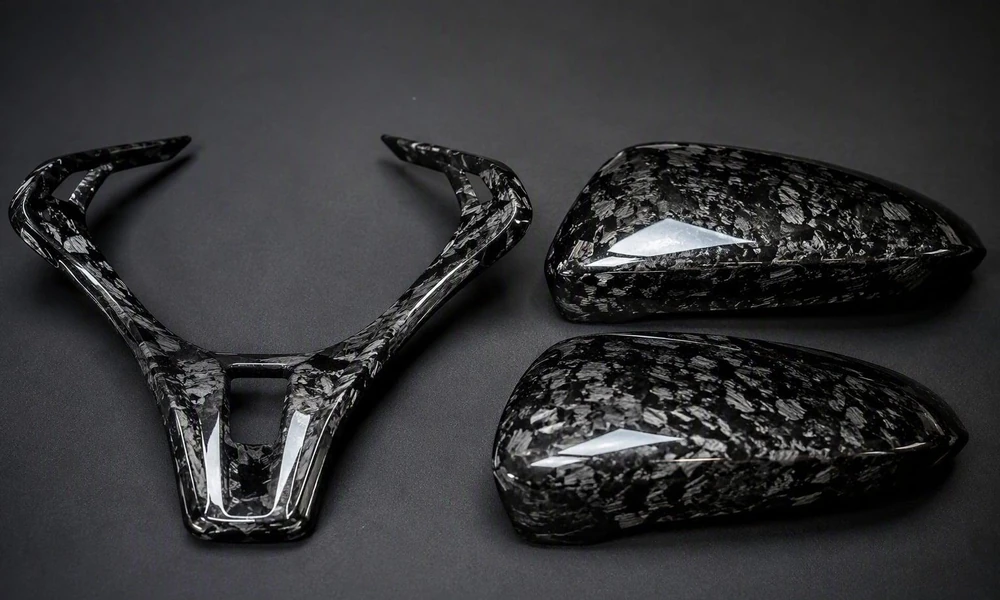
No weave, no repeat, no two alike. This is forged carbon.
It looks like marble. It looks like camouflage. It looks like someone shattered a sheet of carbon fiber and froze the pieces in glass. Forged carbon is the strangest-looking material in the performance car world, and in a little over a decade it has gone from a Lamborghini experiment to the defining surface of modern supercars. Here is what it actually is. And why it exists at all.
What You Are Looking At
Traditional carbon fiber parts are woven: continuous fibers in neat, crossing bundles, like cloth. Forged carbon deletes the weave entirely. Instead, short chopped fibers, roughly 10 to 50 millimeters long, are mixed with resin and compression-molded under high pressure and heat. The fibers settle in random orientations, creating the signature marbled pattern. Every part comes out different, because randomness is the process. The forged carbon vs woven carbon breakdown covers how the two constructions compare property by property.
Why It Is Called ‘Forged’
The name borrows from metal forging, shaping material under pressure, and it fits. Compression molding squeezes the fiber-resin mixture into every corner of a matched metal mold, producing dense, fully formed parts in minutes rather than the hours a hand-laid woven part demands. The process is closer to how metal forgings or injection-molded parts are made than to traditional composite layup, and that difference in process is the source of everything distinctive about the material.
What the Random Orientation Buys
Woven carbon is strong along its fibers. Brilliant in the directions the weave runs, much weaker across them. Designers orient plies to handle known loads, but the directionality never disappears. Forged carbon’s random fibers spread strength in all directions at once: no grain, no weak axis, no orientation engineering required. The trade is a lower ceiling, chopped fiber cannot match continuous weave’s peak directional strength, but for parts where loads arrive from everywhere, multi-directional adequacy beats directional excellence.
The Manufacturing Superpower
The deeper reason forged carbon exists is shape. Woven fabric drapes like cloth. It hates compound curves, deep draws, and complex three-dimensional geometry. Chopped fiber compound flows like a paste, filling geometries that woven layup simply cannot reach. Compression molding also runs fast: cycle times of minutes instead of hours open the door to production volumes that hand layup could never serve. Where woven carbon is craft, forged carbon is industry. And the carbon fiber manufacturing process shows how the two sit side by side in a modern composite operation.
Where You See It
- Supercar interiors and trim: Lamborghini made it a signature, others followed.
- Structural components: suspension parts, subframes, and brackets in low-volume performance cars.
- Aftermarket aero and engine covers: complex shapes at attainable prices.
- Watches, and everything else: the pattern escaped the car world years ago.
How to Read a Forged Part
Quality in forged carbon reads differently than in woven. Forget weave straightness, there is no weave. Instead, check the pattern density: a good part has even, consistent marbling with no resin-rich pools or dry fiber clumps. Check edges and thin sections, where compound flow is hardest to control; thin spots and voids hide there first. And check the back side, as always: uniform texture and clean trimming mean the mold and the charge were right.
Care and Aging
The ownership rules are the same as any composite: the clear coat is the UV armor, and its quality decides whether the pattern stays crisp or chalks into gray fog. Gloss clear over forged marble gives extraordinary depth, the pattern seems to float under glass, while matte turns it into something resembling technical stone. Both age exactly as well as the clear coat lets them, which is to say: buy the finish quality, not just the pattern.
The Honest Trade-offs
Forged carbon is not woven carbon plus a new look. It is a different material with a different contract. You gain complex shapes, multi-directional strength, fast production, and a pattern nobody else has. You give up peak directional strength and the classic woven shimmer. Buyers who understand the trade choose deliberately; buyers who do not are sometimes surprised to learn their forged part and a woven race part are cousins, not twins.
If you are shopping for a forged part today, the practical notes are simple. Expect lead times on less common shapes, because a mold must exist before parts can flow from it. Expect your part to differ from the catalog photo. That is the point, not the defect. And expect questions at every fuel stop, because the pattern still reads as exotic to most eyes. That last part tends to sell owners all over again.
Marble from a mold, strength without a grain, uniqueness as a manufacturing side effect. Forged carbon is what happens when engineers stop trying to make carbon fiber behave like cloth and let it behave like what it is: the strongest paste on earth.
